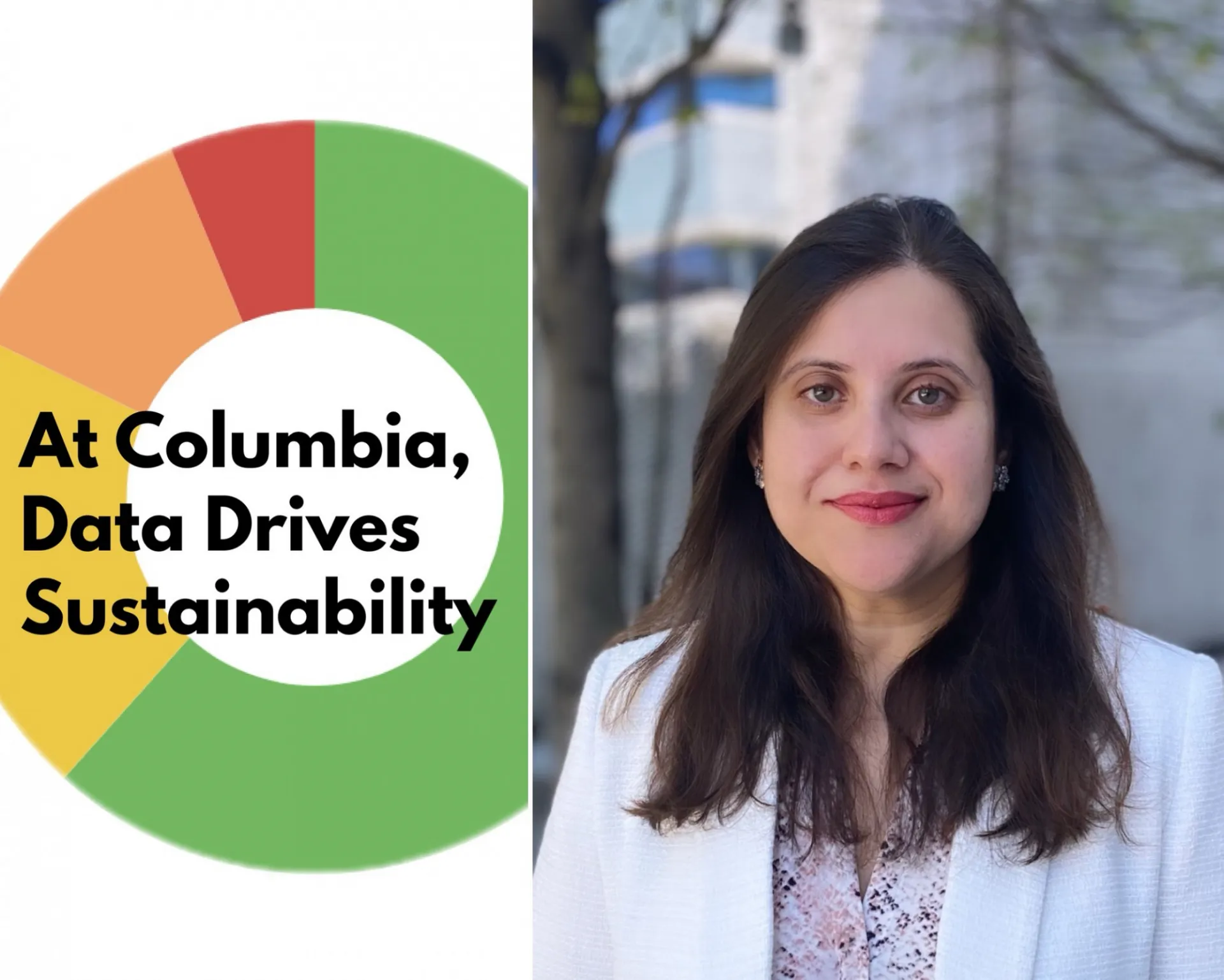
In 2023, Columbia’s Office of Sustainability hired Samreen Afzal as the Director of Analytics – a newly created role that reflects a growing understanding of the importance of data in the field of sustainability. At the heart of Afzal’s work is the use of data to better understand the sustainability efforts that take place across campus.
Afzal collects emissions data from various departments in a rigorous and accurate manner, working to standardize the data acquisition process. She also captures the impact of various sustainability initiatives across campus through quantifying their achieved emissions reductions and other sustainability metrics. This data analytics process links each individual initiative back to the University-wide emissions reduction targets outlined in Plan 2030. Afzal uses this data to generate actionable insights, which are applied to sustainability decisions across the University.
Despite its importance, sustainability data analytics is an emerging field. Although more and more organizations are committing to reporting and reducing their emissions, the lack of industry standardization for emissions data metrics presents a challenge in both accurately collecting the data and comparing progress across different organizations. Furthermore, sustainability initiatives at Columbia take place across a wide range of departments, each of whom use different reporting metrics. Afzal works to bridge these inconsistencies through developing data processes and solutions that attempt to standardize Columbia’s emissions reduction efforts.
The emission reduction targets set forth in Plan 2030 cover a wide range of categories within Scope 1, Scope 2, and Scope 3 emissions, and the data acquisition process is different for each category. Afzal has worked to streamline this process through developing standardized reporting formats that align with The Climate Registry (TCR) reporting guidelines. She has also worked to refine the accuracy and timeliness of the data sources through collaboration with various internal departments.
Compiling data using standardized metrics is crucial as it increases transparency and allows for accurate benchmarking. Moving forward, Afzal hopes to further improve emissions data analytics through initiatives such as real-time data capture and automated emissions data calculations.
Another important component of Afzal’s work is ensuring that the data leads to actionable insights. This necessitates not only a robust system for data management but also a culture of open communication and collaboration across departments. Afzal works closely with various internal departments, including Columbia Residential, Energy Engineering, Campus Services, and Planning and Capital Project Management, as well as external entities like the NYC Mayor's Office of Climate and Environmental Justice and NYC Food Policy. These partnerships are essential for developing coherent and unified strategies that aligns with the university's broader sustainability goals.
Afzal strives to create accessible and interactive data hubs that can be used to consolidate the various sustainability efforts at Columbia University. Her data analytics work touches upon all six commitment areas of Plan 2030, from Campus Energy and Sustainable Transportation to Responsible Materials Management and Water Conservation and Capture. Whether it's analyzing the energy efficiency of campus buildings or assessing the environmental impact of the University's dining services, data is at the forefront of Columbia's sustainability journey.
Looking forward, Afzal is optimistic about the role of data analytics in advancing sustainability at Columbia. Achieving net zero emissions at an institution as large as Columbia requires extensive data management work, and Afzal’s work highlights how data analytics continues to be the backbone of Columbia’s Plan 2030 efforts.