Student Team Delivers Sustainability-Focused Transportation Analysis
A student-led research team from Columbia University's Electric Vehicles Organization (EVO), working in collaboration with the Columbia Clean Energy Group (CCEG), has completed a Campus as Lab (CAL) project examining future transportation options for Columbia's shuttle fleet. Through the project, students applied classroom learning to a real-world operational challenge, delivering a comprehensive analysis for University stakeholders while gaining valuable professional experience in sustainability consulting, research, project management, and stakeholder engagement.
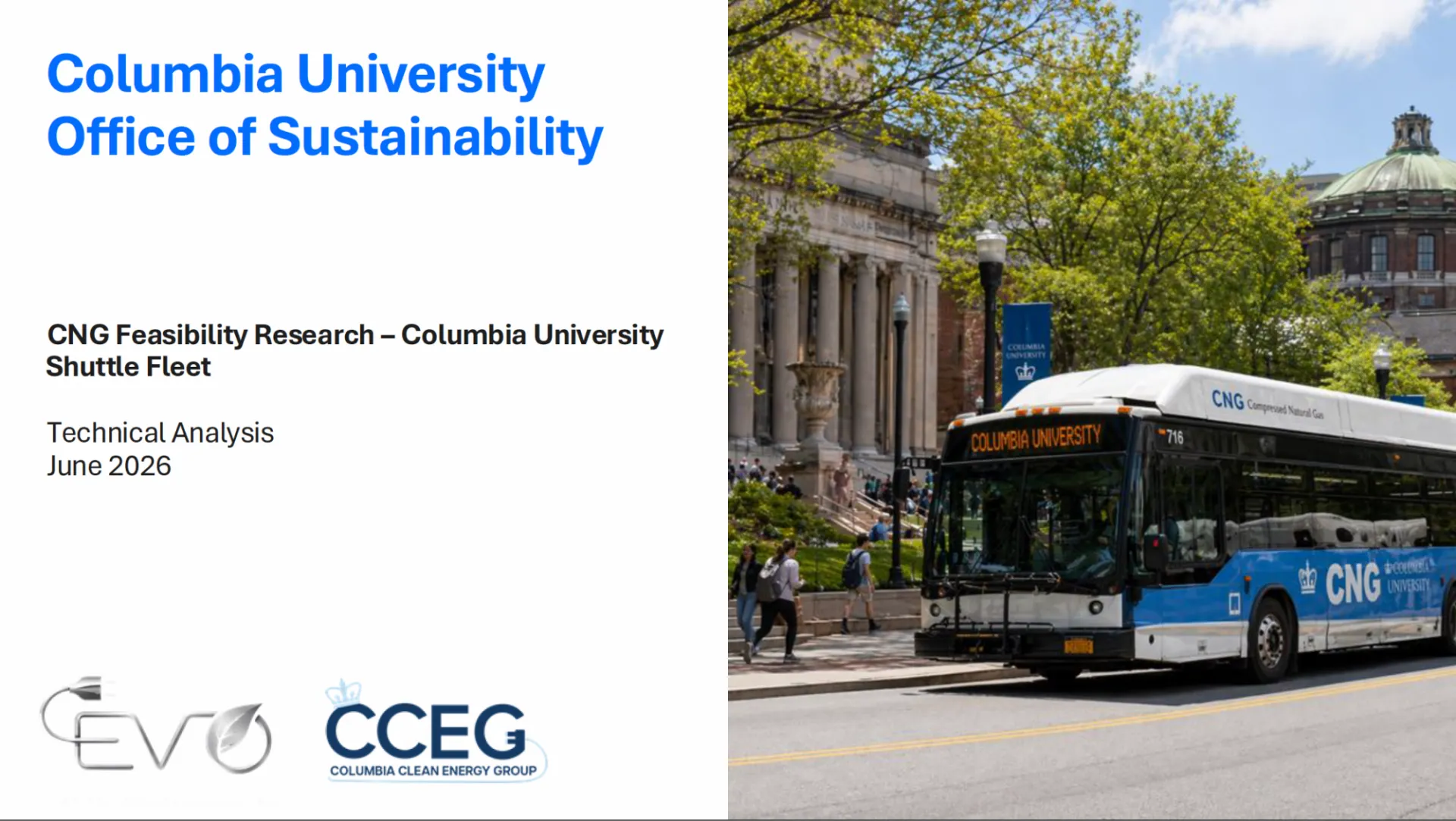
The project exemplifies the CAL model, which connects students with operational challenges on campus and transforms the University into a living laboratory for sustainability innovation. Over the course of the project, the student team conducted industry research, policy analysis, case studies, supplier assessments, and operational evaluations to explore transportation pathways that could support Columbia's long-term sustainability goals while maintaining reliable campus services in the short-term.
Team members worked across disciplines, including sustainability management, engineering, economics, earth science, statistics, and finance, to tackle a complex challenge that required balancing environmental, operational, regulatory, and financial considerations. The experience mirrored the type of cross-functional collaboration students will encounter as future sustainability practitioners, consultants, policymakers, and business leaders.
A central outcome of the project was the team's recommendation that Columbia explore a phased deployment of compressed natural gas (CNG) buses as a transitional strategy for its shuttle fleet while continuing to pursue its long-term electrification and carbon-reduction goals. The students concluded that a contracted CNG model could help address near-term operational challenges associated with aging electric buses while preserving flexibility to adopt future zero-emission technologies as they mature. Rather than recommending a permanent shift away from electrification, the team proposed that stakeholders engage potential operating, vehicle, and fueling partners to validate assumptions and assess whether a CNG bridge strategy could be effective. Based on their analysis, the students identified third-party fueling arrangements and phased implementation as potential ways to minimize risk and capital investment while evaluating long-term zero-emission pathways.
“Harnessing student help to conduct research on actual operational challenges really helps keep us ahead of the curve and is a nice way to add capacity to our operations,” said Mike Pagan, Assistant Vice President of Administrative Services for Columbia University Facilities and Operations.
The project also highlights how student organizations can serve as important partners in advancing Columbia's sustainability mission. Through extensive research and analysis, the team developed recommendations and strategic insights that can help inform future decision-making around campus transportation and fleet operations. Their work contributes to Columbia's ongoing efforts to reduce emissions, improve operational resilience, and evaluate emerging technologies that support the University's long-term sustainability objectives.
“The Campus as Lab initiative is one of six commitment areas of Columbia’s sustainability plan, Plan 2030, which links operational sustainability needs with the educational mission of our academic programs,” said Daniel Allalemdjian, Director of Sustainability and Transportation for the Office of Sustainability. “This has been another great collaboration under the CAL initiative and we couldn't be more pleased.”
For many participants, the project represented an opportunity to gain hands-on experience working with a real client, managing a structured consulting engagement, synthesizing large volumes of technical information, and presenting findings to campus stakeholders. Students were responsible for developing research frameworks, conducting market and policy assessments, evaluating operational considerations, and translating complex findings into actionable insights.
The project was led by Yaseen Ahmid, M.S. Sustainability Management candidate and President of EVO, with project management support from Noemie Remy, M.S. Sustainability Management candidate; Stephanie Brody, M.S. Sustainability Management candidate; and Marco Giordano, B.S. Mechanical Engineering student and Vice President of CCEG. Together, they coordinated the project's research agenda, stakeholder engagement, and final deliverables.
“I wanted the team to feel like they were part of a real-world firm, in the ways they operate and their product delivery, not a group project,” said Yaseen Ahmid, Project Lead and President of EVO. “That's a lot to ask of people who signed up for a student organization, and they met it. I'm proud of what they delivered, and I'm looking forward to our continued partnership with the Columbia Clean Energy Group.”
Supporting the effort as Associate Consultants were:
- Etienne Rouillard, B.A. candidate in Economics
- Madeline Lee, B.A. candidate in Earth Science and Statistics
- Eva Califano, B.A. candidate in Financial Economics
The associate consultants contributed research, analysis, benchmarking, data synthesis, and subject matter expertise that helped strengthen the final recommendations.
“Working on the CNG consulting project for the Office of Sustainability was an invaluable opportunity to gain hands-on experience in the sustainability consulting space,” said Madeline Lee, an Associate Consultant on the project and B.A. candidate in Earth Science and Statistics. “As a first-year undergraduate, I was exposed to complex economic and financial analysis, technical principles, and professional slide-making, a rare opportunity for students my age. I’m extremely grateful to the Electric Vehicles Organization for their collaboration and the Office of Sustainability staff for their support!”
The collaboration also demonstrates the growing role of student-led organizations in supporting sustainability innovation at Columbia. EVO's mission includes connecting students with transportation and clean energy challenges through consulting, research, and experiential learning opportunities, while CCEG provides students with opportunities to explore clean energy through policy, technology, finance, and applied projects.
As Columbia continues to pursue ambitious sustainability goals, projects like this illustrate how experiential learning can generate value for both students and campus operations. The completed study not only provides insights that may inform future transportation planning, but also serves as an example of how students can contribute meaningfully to the University's sustainability journey while preparing themselves to lead similar efforts beyond Columbia.
You can download and view the team’s final presentation here.